

West Peloponnese: Golden Sands, Olive Groves, and the Lure of the Simple Life

The West Peloponnese was our last major stop before heading back north to Ioannina and eventually Corfu for our flight to England.
We stayed at a guesthouse called Beautiful Farm House near Filiatra. Our hosts, George and Dimitra, live on the ground floor while the guest apartment occupies the second. From our balcony, we had an incredible view of the sunset sinking over the wide expanse of the Ionian Sea. As Joanna pointed out, this is the first place on the trip where we saw the sun setting directly over the ocean. The guesthouse is nestled among roughly 80 olive trees along with fruit trees of all kinds—oranges, lemons, figs, walnuts, and grapes. It was also home to three big dogs (the friendliest being Chupana), a cute mother cat, and four tiny kittens. The kids absolutely adored these new friends, playing with them all the time.


Golden Beaches and Sunset Castles
I had originally planned a couple of day trips—like hiking to Neda Waterfalls or driving out to Ancient Olympia—but the laid-back vibe of the area took over. Instead, we ended up hopping between local beaches every day and spending our down time chatting with our hosts.
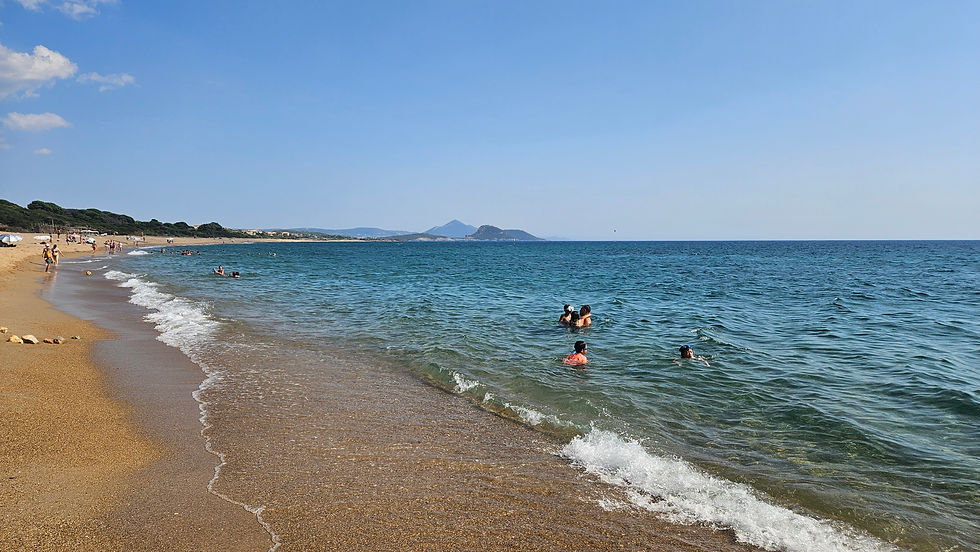
Unlike the pebble shores of Himara and Pelion, the coastline here is defined by long, open stretches of soft golden sand—which was the main reason we chose to come to the West Peloponnese in the first place.
We explored several beaches along the coast:
Voidokilia: The famous horseshoe-shaped bay with calm, shallow waters, flanked by soft sand dunes.
Lagkouvardos: A long beach close to the guesthouse.
Chrysi Akti (Mati): Our absolute favorite—endless golden sand and a wonderful feeling of openness. Apparently the bar on site is also very nice, but we didn’t try it.
Methoni: A lovely beach paired with the dramatic backdrop of Methoni Castle, which looks spectacular as the sun sets over the sea.

Conversations, Wine, and Olive Farming Realities
We spent quite some time eating and drinking, and talking late into the night with George and Dimitra. They shared the hardships they faced when they first moved here from Athens after the financial crisis to rebuild their lives. It was moving to hear their story, and we felt fortunate to be a small part of their ongoing journey.
Both George and Dimitra are incredibly hardworking: Dimitra manages vacation villas in the area, while George attends to his own trees and manages several neighboring properties—looking after roughly 2,500 olive trees in total.
On our second-to-last day, George took us out to visit other olive groves, including another parcel of land he owns. He showed us his vision of acquiring adjacent land to build a better home. In places like Filiatra and Gargalianoi, it’s still possible to find 5,000 m² plots with olive trees for around €40,000.
George also gave us a masterclass in olive cultivation and oil production:
Pruning: Pruning cross-growing branches is essential to allow air and sunlight to pass through the canopy.
Harvest Logistics: During the intense harvest season, hiring seasonal farm labor costs around €75 a day plus coffee and a croissant.
Cold Press vs. Hot Press: George is adamant about cold pressing. While many commercial mills prefer hot pressing to squeeze out higher volumes (yielding 10–12 liters of oil per 45 kg bag of olives), cold pressing yields only 8–10 liters from the same non-irrigated trees—but produces a far superior extra virgin olive oil.


Simple Life in Rapidly Growing West Peloponnese?
I really admire the life George and Dimitra have carved out. Joanna and I also feel the temptation to take on a lifestyle like this—running a guesthouse, growing a small organic farm, and sharing food and wine with travelers. It’s a simple life, though seeing George's daily routine reminded us just how much hard physical work goes into maintaining it.
At the same time, tourism across the West Peloponnese is changing rapidly. Ultra-luxury developments like Costa Navarino and the Mandarin Oriental are shifting the region's profile. Kalamata Airport is set for a major expansion by 2030, and key road upgrades are already underway. Some are comparing the trajectory of this coastline to Portugal's Algarve.
As we watched the sun dip below the horizon on our last night, I couldn't help but think: maybe picking up a small plot of land with a few olive trees around here wouldn't be such a bad idea for retirement down the road!


Comments